
Do you ever feel stuck in a pattern of repetitive arguments that never get resolved? Are you frustrated that your partner never listens; do you often feel criticised or that your opinions are dismissed? How do you manage conflict when it arises in your household? Do you avoid the difficult subjects for the sake of family harmony, or do you prefer to have an argument in the hope of clearing the air only to find you get stuck in a repetitive cycle of accusation and reproach?
If any of this feels familiar, you are not alone. Many couples face the same difficulties, often feeling confused about how they ended up here or worried about what it means for their relationship.

Photo by Vitaly Gariev on Unsplash
Problems with Communication
It is a cliché of the English that we are averse to conflict, and, like all clichés, it is both a lazy generalisation and contains a kernel of truth. Managing conflict is an important skill to a successful and fulfilling relationship and problems with communication is the most common issue that clients bring to relationship therapy. Even when other issues such as concerns about money, or how to parent the children or even the loss of intimacy in the relationship arise, communication is usually at the root of the problem.
Too many relationships become stuck because many of us were never taught how to express our needs clearly, especially when emotions are running high. However, you can learn to overcome these patterns and communicate more fully with your partner.
Some degree of conflict is inevitable. In fact, it is a good thing as it demonstrates that there is energy going into the relationship and all parties are engaged and want to be heard. But if conflicts are to be resolved, it requires assertive communication from all parties and some individuals are more at ease with expressing their needs than others. Assertive communication requires that we acknowledge our own vulnerabilities and have compassion and empathy for our partners and for ourselves.
Differences here are not a sign that something is ‘wrong’ with either partner, but often reflect different histories, family cultures and ways of coping.
How do you communicate an issue with your partner? A simple change of emphasis can change the dynamic in our communication style: try using “I” statements like “I think…” or “I feel…” rather than “we”, “one” or “you”. This simple change in language models constructive communication because you are taking ownership of your comments and clarifies that you are talking about yourself rather than others.
Generalisations like “You always…” or “You never…” will usually be taken by the receiver as criticism and will make communication harder as your partner will become defensive. Remember that beneath the criticism and defensiveness is a longing to be understood, valued and emotionally safe with the person who matters most.
While communication difficulties sit at the heart of many relationship struggles, they often show up alongside other concerns.
Emotional distance and insecurity
Another common problem that couples bring to relationship counselling concerns a feeling of insecurity with each other, that there is an emotional distance that leaves one or both of you feeling disconnected or taken for granted. Over time, these can lead to breaches of trust including keeping secrets, breaking promises or infidelity and leave both partners feeling lonely within the relationship.
These behaviours can strike at the heart of a relationship leading to alienation and conflict often expressed in acts of distancing or silence. This will bring up deeper issues related to each other’s attachment style where those involved feel anxious, avoidant or fearful of abandonment.

Photo by Tijs van Leur on Unsplash
How we were raised by our parents or carers plays a huge part in how we relate to others, and it is important to understand your history if you are to communicate honestly and fully with your partner. How we were cared for will form a sense of how we expect to be treated in a relationship and this information is often so old that it is held at a physical or emotional level where it is less understood by our conscious mind and can easily be misunderstood by our partners.
In the first eighteen months of life, a child learns how to expect to have its needs met by the way it is treated by its parents. If our needs are met with warmth, attention and presence we will develop a sense of emotional security and expect to feel pleasure when we reach out to someone. If a child regularly experiences a positive response, then it will feel confident enough to offer and receive warmth and love.
However, if our needs are met inconsistently, coldly or with ambivalence then the child’s nervous system will react to the stress it feels by flooding the body with the “stress hormone” cortisol and it will resort to survival patterns to manage feelings of distrust and insecurity. In later life, this can lead to sense of shame about our need for love and physical contact. Over time, this experience will become a pattern that has deep roots in the mind. We may seek out a relationship that repeats this pattern because it feels familiar even if it is painful, or because we hope that in repeating the pattern, we can heal it. This will often lead to conflict because it is not our partner’s job to reparent us.
Romantic relationships often bring unresolved attachment issues to the surface but because they operate at an emotional or somatic level they are less easily understood and can be confusing for partners. However, through compassionate dialogue we can foster greater understanding of our partners and what dynamics maybe playing out between us and what we might need now in our adult relationships. If we can understand ourselves and our partners when old triggers emerge, we can transform the way we relate to each other and let go of conflict which is not serving us.
These patterns may feel entrenched, but they can be understood and changed.
Loss of Intimacy
Sexual issues frequently come up in relationship therapy and they can include:
· Mismatched desire levels.
· Loss of intimacy after life changes such as having children, illness or stress at work.
· Difficulties talking openly about sex, our needs or our boundaries.
· Deeper issues of past trauma, sexual abuse and defences against shame.
Differences in sexual desire are often linked to our first topic: communication and conflict. Both subjects are forums where we express our creativity and passion, our fire energy and how we experience it and express it to others. Some of us are naturally creative and spontaneous wishing to engage with others and create something wonderful and joyous. Others may not feel at ease with this side of themselves perhaps due to adverse experiences growing up when our spontaneity or creativity weren’t fostered or encouraged in our families. Whatever your level of confidence in the realm of sensuality and sex, the research suggests that something needs to change.
People who have been together for a long time may find they have lost touch with that side of themselves due to familiarity, the busyness of raising a family, or work and feel that their lover has become more like a flatmate. So, a healthy differentiation is important to a healthy, passionate relationship as is effective communication where all parties can assert themselves appropriately.
The more you understand yourself, the more you will be able to understand others and the more confident you will be to express your needs and negotiate and cooperate with your partner and the happier your relationship will be.
The Orgasm Gap
95% of people orgasm during masturbation but this figure drops for heterosexual or cisgender women to 65% in partnered sex and down to 16% during first encounters. However, orgasms between women with same sex partners are recorded around 85%, which suggests that the discrepancy that heterosexual women are experiencing is due to the quality of the sex being had rather than because female orgasms are more difficult to achieve.
Sex has traditionally been regarded as a linear activity moving through stages, often labelled foreplay, leading to “the real thing” which is assumed to be penetration and ultimately orgasm. This can be described as a goal orientated model of sex.
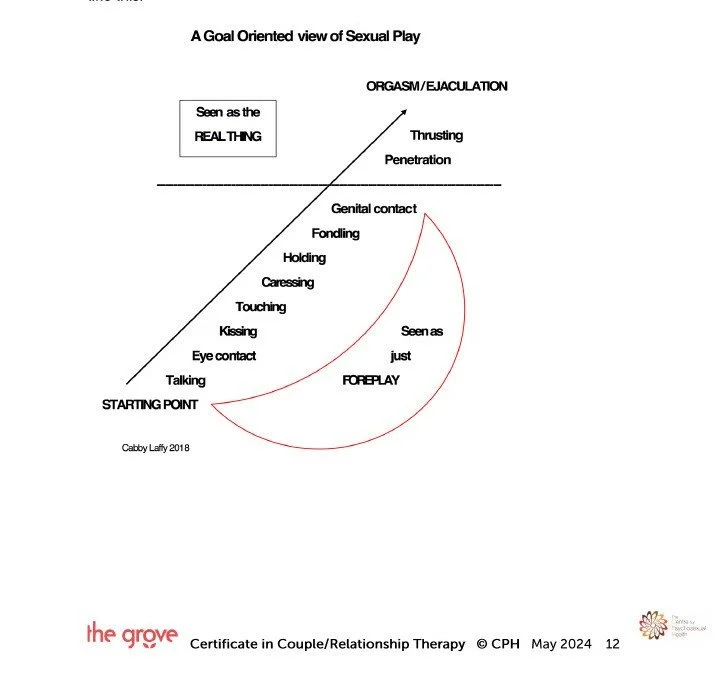
More enlightened thinking suggests that we might like to use a more circular model of sex where many types of sexual activity are regarded as a bouffet of sexual play and all activities are thought of as “the real thing”. In this model, orgasm doesn’t have to be the end of sex and, after a short break, any of the activities in the diagram below could be included. Couples could create their own menu of activities for different occasions depending on the time you have and the size of your appetite.
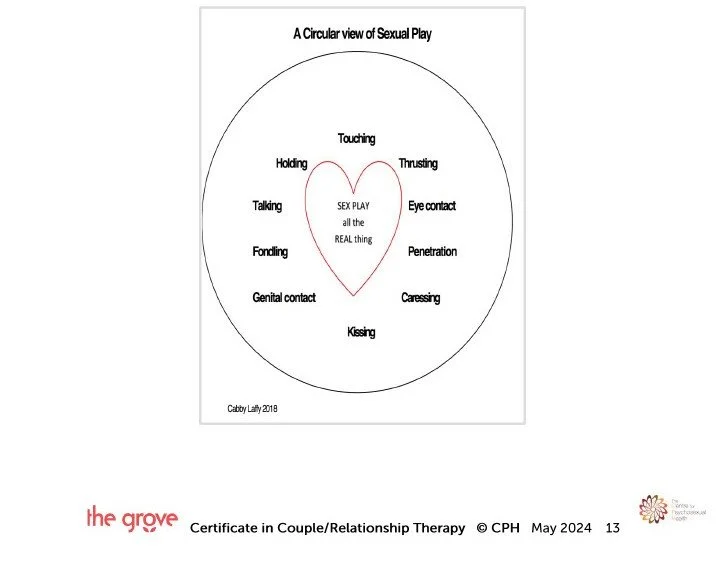
Diagrams from LoveSex and Relationships by Cabby Laffy and Polly McAffee

Photo by kabita Darlami on Unsplash
Relationship therapy is not about assigning blame, but about creating space to understand what is happening between you and why it matters. Many couples find that simply being heard in a new way can begin to shift long-standing patterns so that they appreciate each other more and, crucially, feel more appreciated.
If anything I have written about in this blog has struck a chord with you or if you would like to discuss anything further, don’t hesitate to get in touch.
Tony Austin is an accredited counsellor and psychotherapist offering counselling in Brighton, Hove and online. He works with adults and couples on anxiety, self-worth, relationships, depression and personal growth.